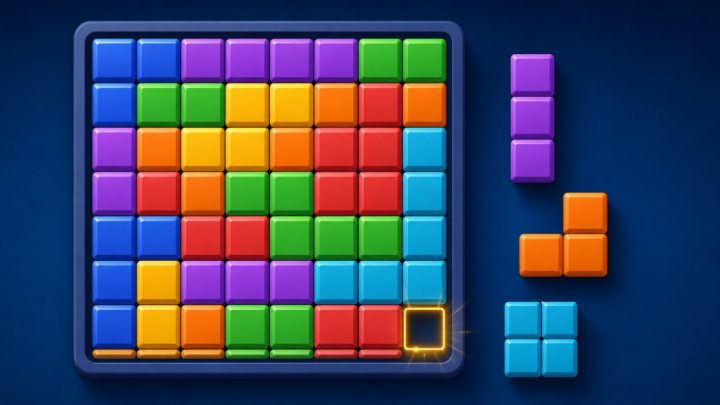
When your Block Blast board is almost full, stop thinking about points for a moment. Your job is to keep the board playable for the next few pieces. A crowded board usually does not fail because it looks messy. It fails because the open spaces are too broken up to use well.
The fastest recovery path is simple: stabilize the board, open space with the least damaging clear, then rebuild around flexibility. If a move scores well but destroys your clean lane or leaves awkward holes behind, it may look helpful while actually pushing the run closer to a dead end.
How to recover a crowded board without making it worse
Use this 3-step recovery method when space starts disappearing:
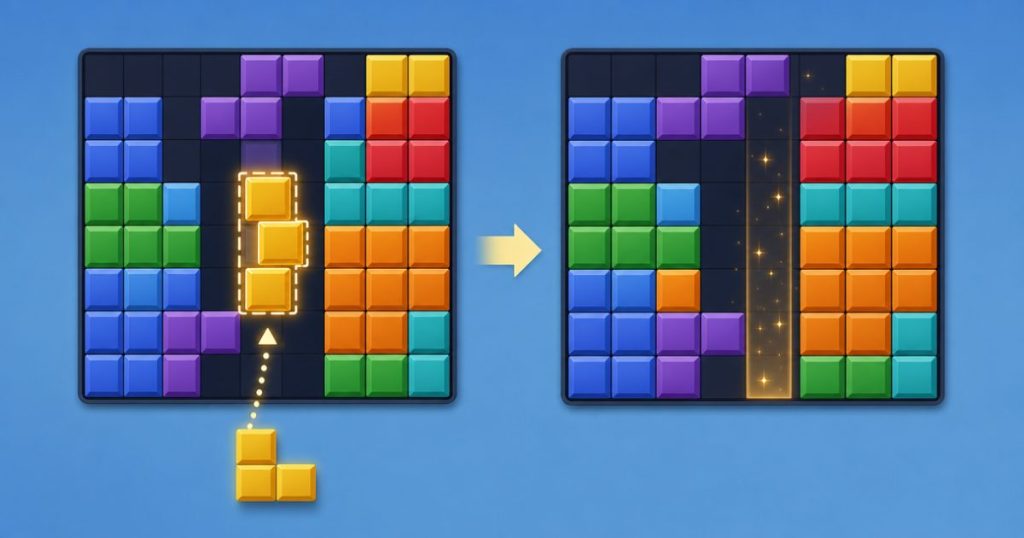
- Stop the bleeding. Don’t place a piece just because it fits. If a move creates a dead corner, blocks a lane, or leaves a hole you cannot realistically fill, avoid it unless there is no safer option.
- Choose the move that opens future space. The best emergency placement is often the one that clears an awkward blocker near the center or keeps a long, flat surface intact. It may not give the biggest immediate score, but it usually gives you more usable board later.
- Rebuild for flexibility. Once you make room, keep the board smooth. Favor placements that preserve flat edges, protect one open lane, and leave room for long pieces or awkward shapes.
This works because a cramped board is usually a space-management problem, not a scoring problem. You are trying to turn a fragmented board back into one that can accept the next two or three pieces without forcing a dead end.
If you want a deeper warning sign guide for run-killing placements, see One Bad Move Can Kill a Block Blast Run — Here’s How to Spot It.
What a good emergency move looks like
A strong recovery move usually does one of these things:
- Removes a blocker near the middle instead of wasting space on the edge.
- Keeps one clean horizontal or vertical lane open for a long piece.
- Turns a jagged area into a flatter surface.
- Clears a small line that unlocks several future placements, even if it is not the biggest clear available.
What it usually does not do is burn your last usable pocket just to force a flashy clear.
How to tell whether the board is still recoverable
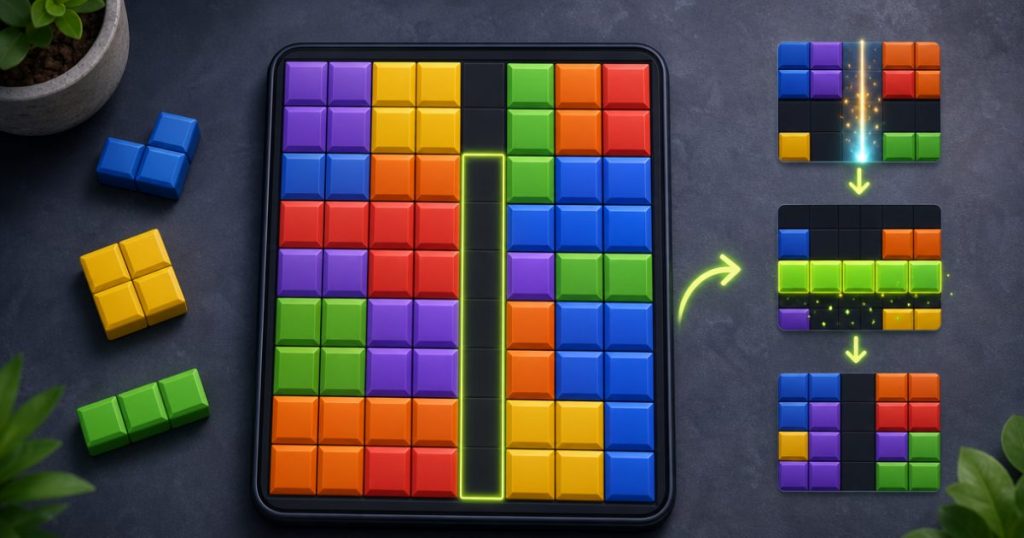
A board is often still salvageable if you have at least one clean lane, a decent pocket for a large block, or a way to clear a blocker that opens several follow-up placements. If you still have two or three different shapes that can fit in different parts of the board, you may be able to recover.
The board is much closer to dead when the empty spaces are split into tiny islands, when every available gap is narrow, or when you have only one possible placement and it destroys your best remaining area. In that case, the right move is usually the least harmful move, not the most ambitious one.
A useful rule: if a placement only works by using up all your best open space, treat it as suspicious. A real recovery move usually leaves at least one useful area for the next piece.
Vertical or horizontal space: which matters more when the board is tight?
When the board is crowded, protect the space that helps both the current piece set and the next one. In practice, that usually means keeping the cleaner line, not just the bigger-looking gap.
- Protect a vertical lane if long pieces or narrow shapes are likely to show up.
- Protect a horizontal lane if it keeps the center open and stops the board from splitting into separate sections.
The main point is not to lock yourself into one orientation forever. It is to avoid placements that destroy both at once.
Common panic moves that usually end the run
When players feel squeezed, they often make the same mistakes:
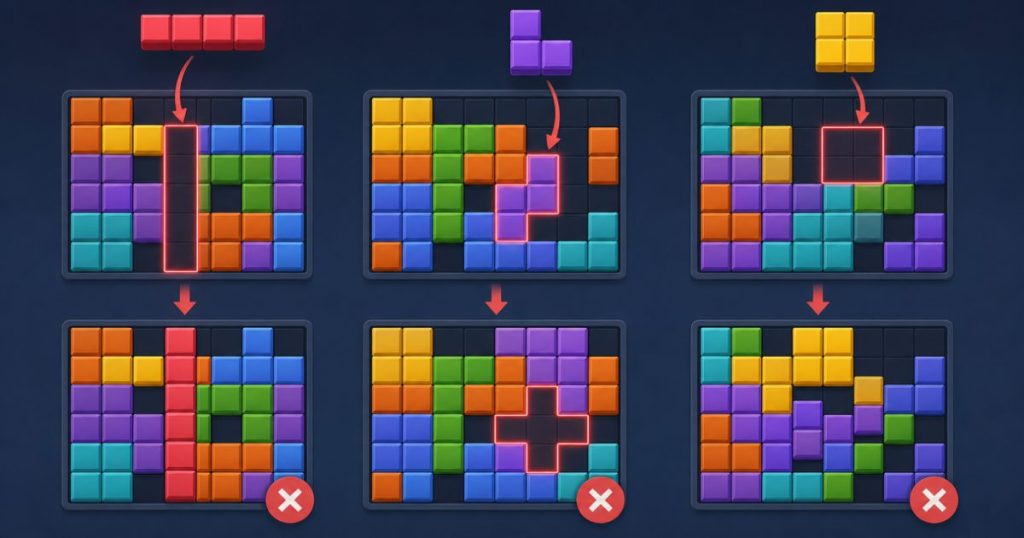
- Chasing the biggest clear. A larger clear can be worse than a smaller one if it leaves a hole you cannot reuse.
- Filling the center too early. The middle is often where you still need flexibility. Locking it up can make the board brittle fast.
- Ignoring the next two or three pieces. Looking only at the current block makes it easy to miss a trap created by the following shape.
- Creating jagged edges. Uneven surfaces are harder to recover from than clean, flat board edges.
- Burning the only long lane. A move can fit now and still be the one that ends the run if it removes your last good channel.
That last point matters a lot. A move can look safe because it works on the current turn, but if it removes the only region where a long piece could go, it may be the move that actually ends the run.
A simple decision rule under pressure
If two placements are both legal, choose the one that leaves the board flatter, keeps the center more open, and protects the most future options. If one option clears more but creates a dead corner, the smaller clear is often the smarter recovery move.
That is why a crowded board is less about perfect play and more about avoiding the wrong kind of damage. Players who survive longer usually learn to spot dead corners, narrow channels, and fragmented open areas before those problems become unrecoverable.
If you are still learning how to judge risky placements, the piece-order guide can help you think one move ahead: Block Blast Piece Order: Which of the 3 Blocks Should You Play First?
Frequently Asked Questions
What should I do first when my Block Blast board feels almost full?
Stop placing pieces automatically. Look for the move that causes the least damage to your future space, not the move with the biggest immediate payoff.
Should I always take the biggest clear available?
No. A smaller clear is often better if it keeps a clean lane open, avoids a dead corner, or preserves a flat surface for the next piece.
How do I know if the board is already unrecoverable?
If the open spaces are split into tiny fragments and every possible placement burns your last useful lane or pocket, the board is probably too far gone.
When your board starts to fill up, pause before you place anything. Ask one simple question: does this move open future space, or does it squeeze the board tighter? That check will save more runs than chasing a bigger clear in a bad position.
If the board still has one clean lane, one useful pocket, or one blocker that opens several options, you probably still have a recovery path. If every empty space has broken into tiny gaps, the better lesson is to make the next run cleaner before the board reaches that point again.