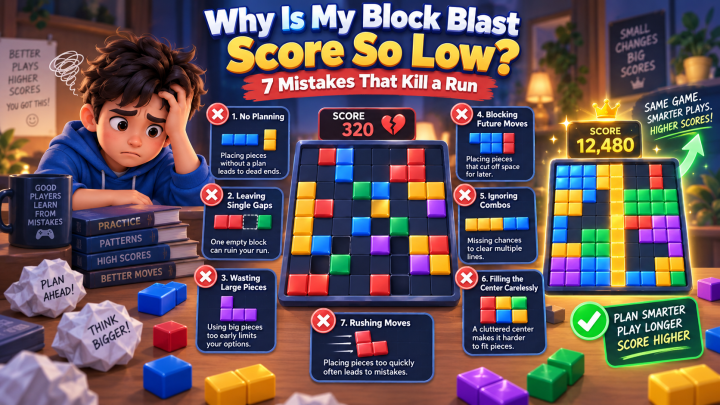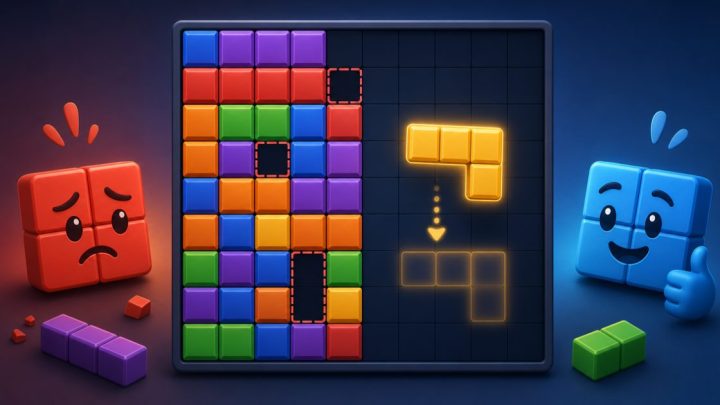
If your Block Blast score has stalled, the problem is usually not the game itself. It’s the way you’re placing pieces. Most plateaus happen when players keep making the same safe-looking moves that slowly damage the board, create awkward gaps, and reduce the number of good options on later turns.
The fix is to protect flexibility. Keep usable space open, avoid dead pockets, and choose placements that help the next few turns instead of only solving the current one. Once you start judging moves by how they affect the board later, higher scores become much easier to repeat.
Why your score stops climbing
The most common reason for a plateau is reactive play. You look at the piece you have, drop it where it fits, clear a line if one appears, and move on. That works for a while. Then the board starts filling with narrow gaps, awkward corners, and isolated spaces that your next pieces cannot use well.
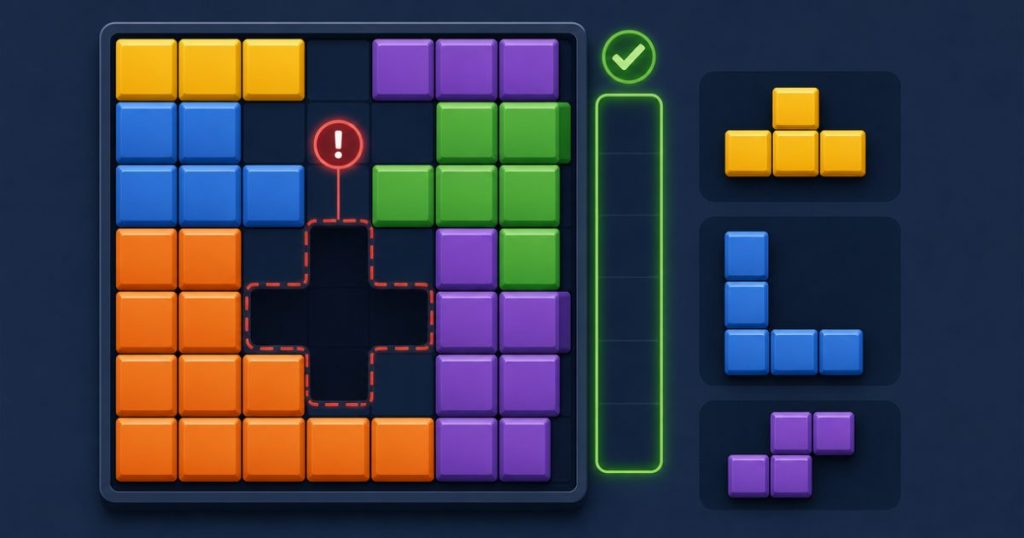
At that point, your score is limited less by puzzle skill and more by board shape. If each placement shrinks your legal options, you’ll run out of room sooner and lose the long runs that lead to better scores.
This is why some players feel stuck even after they understand the basics. They are not making huge mistakes every turn. They are making small decisions that slowly reduce flexibility. One bad gap may not end a run right away, but it can block the larger shape you needed a few turns later.
A plateau can also come from style. Some players become too cautious and stop making moves that would open the board. Others clear too eagerly and keep chopping the board into awkward pieces. Both habits can cap your score. The better approach is to preserve space while still taking the clear that actually improves the board.
The decision rule that matters most
Before you place any piece, ask one question: Does this move make the board more flexible, or less? If it makes the board less flexible, the move needs a strong reason to exist. That reason might be opening a lane for a difficult piece, preventing a dead end, or setting up a better placement on the next turn.
Flexibility is not just about empty squares. It’s about usable empty squares. A wide open area with one strange notch cut into it can be worse than a smaller clean space, because the notch may block future shapes. That is why the best placements usually preserve straight edges, clean channels, and simple board geometry.
Two things matter most here:
- Shape compatibility: leave room for the pieces you are likely to receive, not just the one in front of you.
- Space preservation: avoid breaking the board into tiny pockets that only rare shapes can use.
Think in terms of board health. A move that clears one line but leaves a trapped pocket can be worse than a move that scores nothing and keeps your next few turns playable. That does not mean you should ignore clears. It means you should take them when they improve the board’s long-term shape, not when they only give you a small immediate reward.
Common habits that silently cap your score
One common mistake is forcing pieces into bad spaces just to avoid “wasting” them. In Block Blast, a piece is not wasted if you keep the board open. It’s wasted when the placement turns the board into a trap.
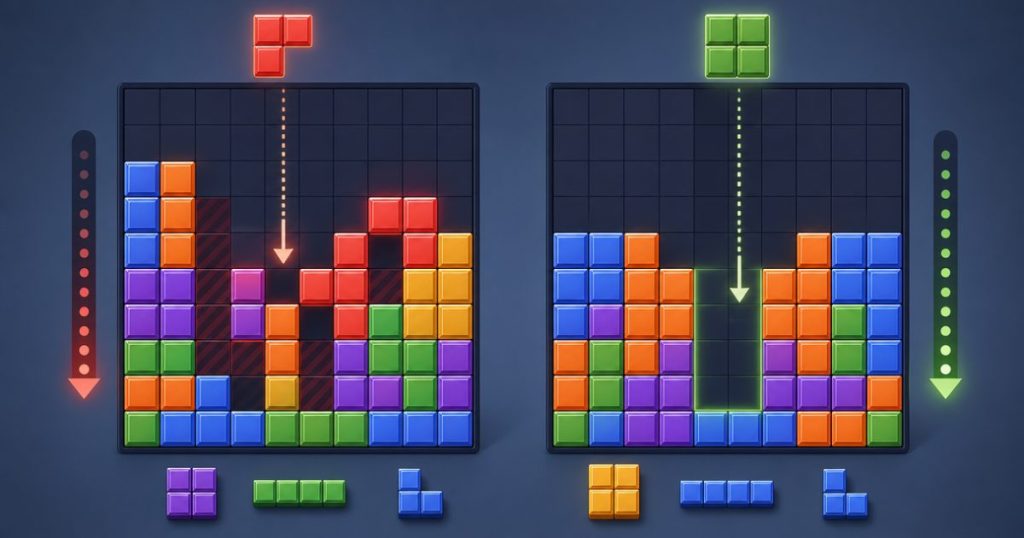
Another is clearing too early. A clear feels productive, so players often take it the moment it appears. But an early clear can destroy a stable layout and leave you with a board that is harder to manage. If the clear does not create better future options, it may be hurting you more than helping you.
The opposite mistake happens too. Some players preserve the board so aggressively that they let the middle fill up and lose room for larger pieces. That is how a careful run suddenly becomes unplayable. The goal is not to avoid clearing. It is to clear in a way that keeps the board open enough for what comes next.
Center control matters here. Filling the middle too early usually reduces your options faster than edge stacking does. The center is where awkward placements become permanent problems. Edges, by contrast, can often absorb imperfect shapes more safely, especially if you keep them clean and build along straight lines.
If you want a deeper look at one of the most common failure patterns, this guide on the Block Blast 3×3 problem explains why small gaps can end strong runs so quickly.
How to judge a move before you place it
Good players do not just ask, “Does this fit?” They ask a few faster but more useful questions:
- Will this placement leave a clean space for a larger piece?
- Does it create a pocket, notch, or tunnel that may be hard to use later?
- Will I still be able to place awkward shapes if the next draw is bad?
- Am I improving board shape, or just reacting to the current piece?
That last question is the simplest and most useful. If your move only solves the present turn, it may not be a good move. If it helps the next two or three turns stay manageable, it is usually worth more than a short-term clear.
A practical way to think about this is to compare immediate points with future potential. An immediate clear gives you something now. Future potential gives you more legal placements later, which is what keeps a run alive long enough to build a higher score. The runs that reach better scores usually favor future potential more often than reactive scoring.
This is also where risk management matters. A riskier move is worth it when it opens a stable, high-value lane or prevents a dead board state. It is usually not worth it when it only creates a temporary opening while damaging the rest of the board. If the move looks clever but leaves you with a thin, awkward shape, it is probably lowering your expected score.
What to change in your placement priorities

If your score has plateaued, one of the easiest ways to improve is to change the order of your priorities. Most players start with the visible clear. Better players start with board shape.
Use this order during a run:
- Protect open space so the board stays flexible.
- Keep the center manageable instead of letting it become cluttered.
- Use edges and corners for pieces that would otherwise break the board’s structure.
- Take clears that improve future options rather than clears that only feel satisfying.
- Save clean lanes for awkward pieces and long shapes.
Edge placement is especially useful when you need to keep the middle open. A clean edge can absorb a long bar, a squat shape, or a strange leftover piece without harming the rest of the board. Edge stacking fails when it becomes lopsided and creates a wall of unusable pockets, so the goal is to support the board, not just push clutter outward.
It also helps to remember that survival and scoring are linked. Longer runs are not just safer; they create more chances to score. You cannot chase a bigger score if the board collapses before the better pieces appear. The more stable the board stays, the more opportunities you have to make useful clears instead of desperate ones.
How to recover after the board gets messy
Everyone makes a bad placement sometimes. The next few moves matter more than the mistake itself. Once the board gets messy, the goal changes from building the best board to stopping it from getting worse.
Start by looking for the safest placement that preserves flexibility, even if it does not score much. Avoid the urge to dig into the middle just because there is space there. If the center is already awkward, a move that preserves a clean edge or lane is often the better recovery play.
In a crowded board, a useful rule is this: do not create a second problem while trying to solve the first. If you already have one bad gap, do not add two more. If you have to spend a piece in an imperfect place, at least keep the rest of the board simple.
When the board is close to dead, focus on moves that reopen straight lines or restore a usable corridor. Sometimes that means giving up an immediate clear. Sometimes it means placing a piece in a less obvious spot so a future bar, square, or corner piece still has a home. If you want a step-by-step way to calm a crowded board, this guide on recovering a full Block Blast board is a useful companion read.
If your runs usually collapse after you start playing on autopilot, slow down for a few turns and reassess the board shape. The game often rewards the player who spots the trap before placing into it.
A quick self-check to use during every run
If you want a simple way to break through a plateau, use this quick check before each move:
- Will this placement keep at least one clean area open?
- Am I protecting the center, or filling it without a plan?
- Does this move help the next piece, or only the current one?
- Am I clearing because it helps the board, or because I want the points now?
- If the next three pieces are awkward, will I still have options?
These questions do not guarantee a higher score, but they do cut down on the habits that silently limit one. That matters more than chasing a perfect move every turn. Block Blast is usually won by consistency, not by a single brilliant placement.
Once your decisions start protecting flexibility instead of just reacting to pieces, your runs will last longer and your scores will become less dependent on luck. That is the shift that gets players past a plateau.
If your score has stalled, start by changing what you value in a move. Do not ask only whether a piece fits. Ask whether the placement keeps the board flexible enough for the next few turns.
The fastest improvement usually comes from cleaner space management, fewer trapped gaps, and more patience around clears. Once those habits become automatic, higher scores stop feeling random and start feeling repeatable.