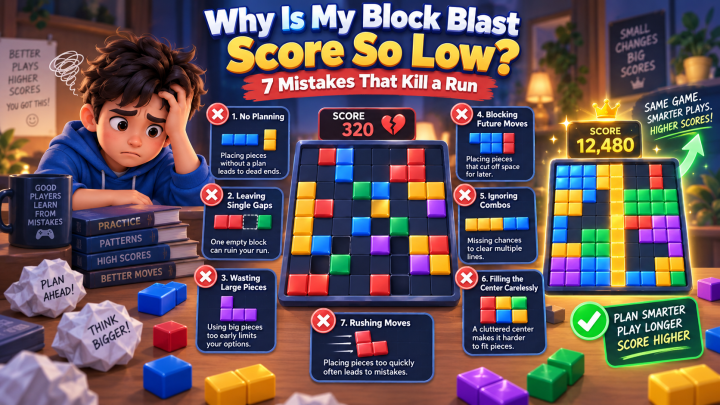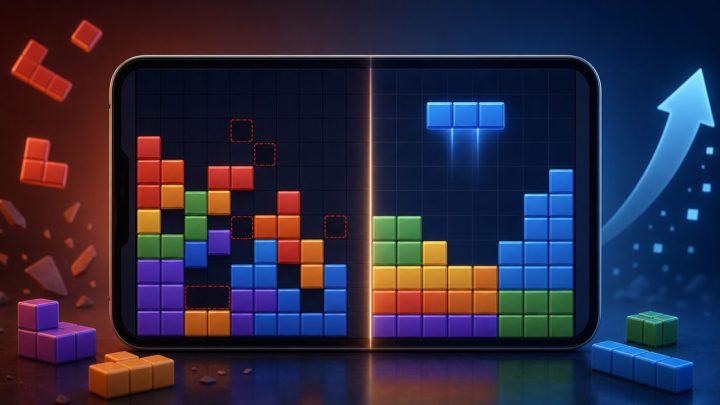
Block Blast feels simple because its rules are easy to understand: place shapes on a grid, complete rows or columns, and keep the board from filling up. The difficulty comes from the decisions hidden inside that simplicity. Every piece changes the future shape of the board, and every cleared line creates a brief sense of relief before the next problem appears. Players using blockblastonline.me often notice that a short session can quickly turn into an attempt to beat one more score, survive one more turn, or recover from one difficult placement.
The Core Reason Block Blast Feels So Compelling
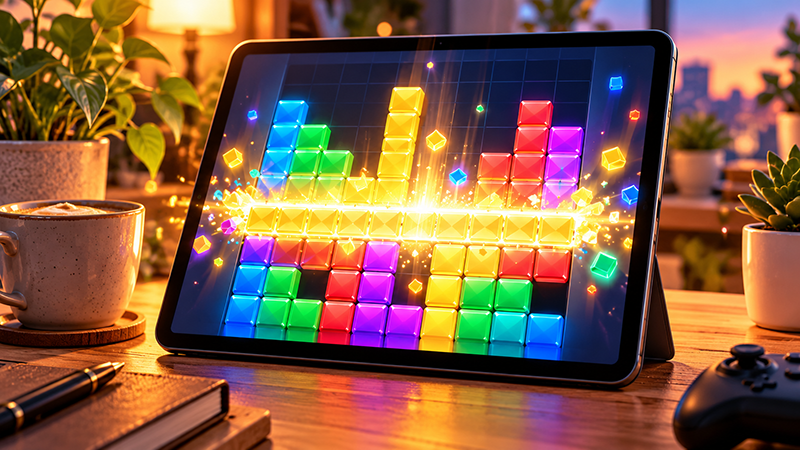
The game combines several psychological rewards in a very small space. It offers clear goals, immediate feedback, manageable decisions, and unpredictable challenges. None of these features needs to be complicated on its own. Together, they create a strong loop:
- A new set of pieces appears.
- You scan the board for possible placements.
- You make a decision with limited information.
- Rows or columns disappear, producing visible progress.
- The cleared space makes another move possible.
- The next pieces create a new problem.
This loop is quick enough to maintain attention but varied enough to prevent every turn from feeling identical. The player is constantly switching between planning, reacting, and evaluating risk.
Simple Rules Reduce Mental Friction
Block puzzle games are easy to begin because the basic objective does not require a long tutorial. There are no complicated controls to memorize and usually no need to understand a large fictional world, character system, or inventory. The player can focus almost immediately on shape, space, and timing.
This low entry barrier matters psychologically. A player can start a game during a short break, understand the important rules within moments, and still feel that each later move requires skill. The game is accessible without being completely predictable.
That balance is one of the main sources of its appeal. If the rules were difficult, many casual players would stop before reaching the satisfying part. If the game solved itself, experienced players would lose interest. Block Blast sits between those extremes: the actions are simple, but the consequences are not.
Immediate Feedback Makes Every Move Feel Meaningful

Human attention responds strongly to visible cause and effect. When a placement completes a line, the board changes immediately. Space opens, the score increases, and the player receives confirmation that the decision worked.
This feedback gives even a small action a clear result. A move is not merely a shape being added to a grid; it may also be:
- A successful line clear.
- The beginning of a combo or chain of clears.
- A rescue that creates room in a crowded area.
- A setup for a stronger future placement.
- A mistake that teaches the player what to avoid next time.
When a move produces several benefits at once, the reward feels especially strong. Clearing multiple lines, preserving an open section, and preparing for the next piece can make one decision appear highly efficient. The player begins looking for these efficient moments repeatedly.
Uncertainty Creates Tension Without Making the Game Confusing
A major difference between a puzzle and a routine task is uncertainty. You may know the available pieces, but you do not know exactly what will appear later. That limited information forces you to balance current gains against future flexibility.
If every upcoming piece were known far in advance, the game would become a calculation exercise. If pieces arrived with no understandable relationship to the board, decisions would feel random. The engaging middle ground is uncertainty with enough control to support planning.
Players therefore ask questions such as:
- Should I clear a line now or preserve this opening?
- Is this narrow gap worth keeping for a specific shape?
- Can I place the awkward piece without blocking the center?
- Am I using too much of the board for a small immediate gain?
- How many useful placements will remain after this move?
These questions create tension, but they are not overwhelming because each turn still offers a limited number of practical choices. The player is solving a small problem repeatedly rather than facing one enormous puzzle all at once.
The Near-Miss Effect Encourages Another Attempt
Many players stop only after a run ends, but the end of a run often contains a psychological trap: the feeling that success was almost possible. Perhaps one more line would have opened the board, or a different placement might have prevented the final blockage.
This is a near-miss. It is not the same as winning, but it suggests that improvement may be close. The player can identify a possible correction, such as leaving more room for large pieces or avoiding a sealed corner. Because the mistake seems understandable, starting again feels reasonable.
Near misses are particularly powerful in games with short restart times. There is little delay between failure and another attempt, so the player can immediately test the revised strategy. That makes the next game feel like a continuation of the previous lesson rather than a completely separate activity.
Why Clearing Lines Feels So Satisfying
Line clearing provides both order and release. The player sees an incomplete pattern, supplies the missing structure, and watches the obstruction disappear. This resembles a small act of problem resolution: confusion becomes space, pressure becomes control, and a crowded board becomes manageable again.
The satisfaction increases when a clear solves more than one problem. For example, a single placement might complete a horizontal row while also finishing a vertical column. It may remove a difficult block and create room for a large shape at the same time.
These multi-purpose moves reward players for thinking beyond the next empty square. The best decision is often not the one that fills a convenient gap immediately. It is the one that improves the board in several directions.
Progressive Difficulty Keeps Attention Focused

As a run continues, the board usually becomes more demanding. Open areas shrink, awkward gaps appear, and each placement carries greater risk. This gradual pressure helps prevent boredom. Early moves allow experimentation, while later moves require more careful judgment.
The changing difficulty also produces a natural rhythm:
| Stage of a run | Typical mental focus | Useful priority |
|---|---|---|
| Early board | Creating a flexible foundation | Keep several areas open |
| Middle board | Balancing clears and future options | Avoid narrow, isolated spaces |
| Crowded board | Managing immediate threats | Find the safest space-making move |
| End of a run | Recognizing unavoidable blockage | Learn which earlier decision caused it |
This progression makes a score feel like a record of decision quality, not merely time spent playing. A longer run suggests that the player managed uncertainty effectively for more turns.
The Game Rewards Both Planning and Improvisation
Block Blast is not purely a planning game. Long-term planning is useful, but the player cannot perfectly predict every future piece. Strong play requires a combination of preparation and adaptation.
Planning means preserving useful structures. You might keep an open central area, avoid filling all corners, or leave a gap that can accept more than one shape. These decisions increase flexibility.
Improvisation begins when the next pieces do not fit the original plan. Instead of forcing the intended move, you reassess the board. The question changes from “How do I complete the pattern I wanted?” to “What is the safest pattern available now?”
This combination supports a valuable feeling of competence. A player can improve through better habits without needing complete control over the pieces. Skill appears as the ability to reduce bad outcomes, not as the ability to guarantee a perfect board.
Why Scores and Combos Matter Psychologically
Scores turn invisible improvement into something measurable. A player may not know exactly how much better their board management has become, but a higher score provides evidence that a strategy worked.
Combos add another layer because they reward timing and continuity. Clearing lines in succession feels more valuable than making isolated clears, even when both actions remove space. The player is encouraged to think about how one move prepares the next.
A useful way to understand scoring motivation is to separate three goals:
- Survival: keeping the board playable for as long as possible.
- Efficiency: removing lines while using space carefully.
- Optimization: creating combinations, larger clears, or higher-value sequences.
Beginners usually focus on survival. As their confidence grows, they begin taking calculated risks for efficiency and optimization. This gives the game room to remain interesting after the basic controls are familiar.
Why People Keep Playing After a Mistake
Mistakes in a block puzzle game are usually visible and specific. You may recognize that you filled a useful gap too early, created an isolated hole, or placed a large piece where it restricted later options. That clarity makes the mistake feel correctable.
When failure has a clear cause, players are more likely to replay. They can form a testable rule for the next attempt:
- Leave at least one broad open region instead of spreading small gaps everywhere.
- Do not chase an immediate clear if it destroys future flexibility.
- Place awkward pieces before the board becomes too crowded.
- Check all available pieces before committing to the first acceptable move.
The next run then becomes an experiment. If the new approach lasts longer, the player receives confirmation. If it fails differently, another adjustment becomes possible. This learning loop is one reason the game can feel productive even when the score is not a personal best.
How to Enjoy the Game Without Losing Control of Time
The same qualities that make Block Blast engaging can make a session longer than intended. Immediate restarts, unfinished goals, and near misses encourage continuous play. A simple boundary can help: decide before starting whether you will play for a fixed number of rounds, a specific amount of time, or until you reach a defined practice goal.
It can also help to give each session a purpose. One session might focus on keeping the center open. Another might focus on reducing isolated holes or evaluating pieces before placement. This turns repeated play into deliberate practice rather than automatic restarting.
The Lasting Appeal of Block Blast
Block Blast is addictive in the everyday sense because it compresses several powerful game design elements into a clear, repeatable activity. The rules are accessible, decisions have immediate consequences, outcomes remain partly uncertain, and improvement is easy to measure. Every cleared line offers a small reward, while every crowded board presents a new problem to solve.
Its strongest feature is the balance between control and uncertainty. You are responsible for each placement, but you must respond to conditions you did not choose. That tension keeps the game mentally active without requiring a large time commitment or complicated controls.
The most productive way to approach the game is to treat each run as both a challenge and a lesson. Look for the move that preserves future options, study the placement that caused the board to collapse, and value flexible space as much as immediate points. Once those habits become natural, the appeal becomes clearer: the game is not simply about fitting blocks together, but about making good decisions under pressure, one small move at a time.