“Winning” Block Blast is less straightforward than beating a traditional level-based game. There is usually no final boss, campaign ending, or single screen that proves you have completed everything. Instead, the game tests how long you can keep a changing board under control, how efficiently you clear lines, and how well you recover when the available pieces become awkward. For many players, the real victory is not simply placing the next block. It is preserving enough space and flexibility to keep playing several turns later.
Players who want a quick browser session can use blockblastonline.me to practice the same core skills: reading the board, managing empty space, setting up clears, and avoiding placements that create unnecessary problems.
What Does It Mean to Win Block Blast?

There are several valid definitions of winning, and the best one depends on what you are trying to improve. A new player may consider a run successful if they understand the placement rules and beat their previous score. A regular player may aim to survive longer, create more combos, or set a personal high score. An advanced player may judge success by the quality of the board rather than the points shown on the screen.
In practical terms, a Block Blast win can mean one or more of the following:
- Completing a short session without running out of moves. This is a useful beginner milestone because it shows that you are thinking beyond the immediate piece.
- Beating your personal best. Since each run can produce a different sequence of pieces, personal improvement is more meaningful than comparing every result with an arbitrary score.
- Surviving a difficult board state. Recovering from a nearly full grid demonstrates stronger decision-making than maintaining a comfortable opening position.
- Building a long clearing streak. Consecutive clears can improve scoring and, more importantly, show that your placements are supporting one another.
- Finishing with control rather than luck. A high score created by several fortunate pieces is satisfying, but a repeatable strategy is the stronger achievement.
That last distinction matters. A single excellent run does not always prove that you have mastered the game. A better measure is whether you can consistently avoid unnecessary dead ends and make reasonable choices when the pieces are inconvenient.
The Core Objective: Preserve Future Options
Every placement changes the number of useful moves available on the next turn. A move can clear a line immediately and still be strategically poor if it divides the board into awkward gaps. Conversely, a placement that produces no immediate clear can be excellent if it leaves several open areas for future pieces.
This is why the largest empty area is not always the most important part of the board. What matters is the shape and accessibility of that space. A wide, connected area can accept many different blocks. A collection of narrow holes may contain plenty of empty squares but be unusable because no available piece fits them.
Before placing a block, ask three questions:
- What does this piece clear now? Check whether it completes a row, column, or another available clearing pattern.
- What spaces will remain afterward? Look for large connected regions rather than counting empty squares alone.
- Which future pieces could become impossible? A placement that blocks the only area for a long shape or large square may create a problem that does not appear immediately.
This simple pause prevents many avoidable mistakes. The most tempting move is often the one that gives the fastest visible reward. The strongest move is frequently the one that leaves the board easiest to solve.
Why Immediate Clears Are Not Always the Best Move
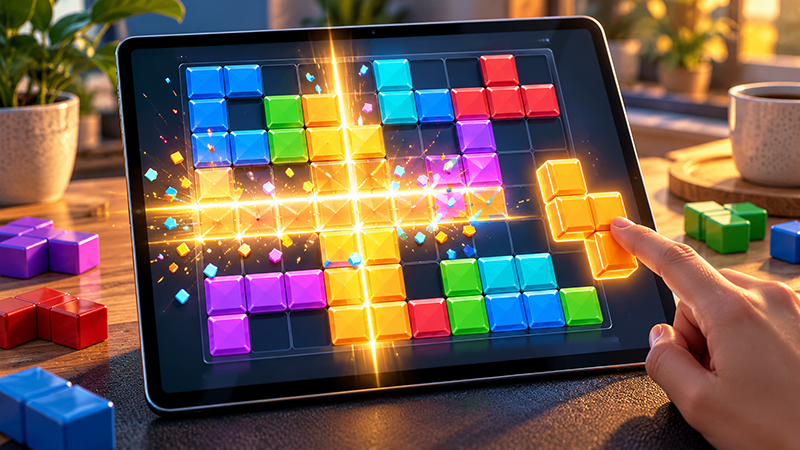
Clearing a line feels like progress, so players naturally prioritize it. In many positions, that is correct. A clear removes occupied cells, creates room, and may extend a combo. However, clearing at the wrong time can damage the structure of the board.
Imagine a nearly completed row near the bottom of the grid, with a large open area above it. You have a piece that can complete the row, but placing it would also split the upper area into two thin sections. If the next pieces include long horizontal blocks, the clear may help. If the next pieces require a larger connected region, the same move may leave you trapped.
Delaying a clear is reasonable when:
- The line can be completed later without blocking an important area.
- The current piece fits safely in a less useful part of the board.
- Keeping the almost-complete line helps create a second clear or a combo.
- The immediate clear would isolate holes or divide the board into narrow channels.
Do not treat this as a rule to avoid clearing. A delayed line is also a form of risk. If you wait too long, the unfinished row may become a permanent obstacle. The correct question is not “Can I clear now?” but “Does clearing now improve my next few moves?”
Board Management: Build Structure, Not Towers
A common losing pattern is allowing one side of the board to become much taller than the other. Players often stack pieces in the most convenient location, creating a high wall while leaving open space elsewhere. This may work for a few turns, but it reduces the number of orientations and shapes that can be placed safely.
A more stable board usually has a relatively low, connected surface. It does not need to be perfectly flat. Some unevenness is useful because it creates opportunities to complete lines. The danger comes from deep holes, isolated columns, and tall sections that cannot be reduced easily.
Try to maintain these conditions:
- Keep the central area usable instead of filling it with random blocks.
- Avoid creating single-cell holes that cannot be reached by the available shapes.
- Do not build a tall column unless it directly supports a planned clear.
- Preserve at least one broad region for large or awkward pieces.
- Use the edges for pieces that fit naturally there, but do not permanently seal an edge with a bad overhang.
Edges can be helpful because they provide natural boundaries. They can also become traps. A piece placed against an edge may leave a gap that only a specific shape can fill. Before using an edge, check whether the remaining space beside it is still accessible.
How to Think About the Three Available Pieces
Many Block Blast decisions become easier when you evaluate the group of available pieces as a set rather than choosing one at a time. A piece that looks difficult on its own may be the key to preparing the board for another piece.
Use this sequence:
- Identify the most restrictive piece. Long bars, large squares, and unusual angles generally need more specific space than small blocks.
- Find a safe home for that piece first. It does not necessarily need to clear a line, but it must not destroy your remaining options.
- Look for a placement that changes the board favorably. A small piece may complete a line or create room for the restrictive one.
- Consider all possible orders. Placing the pieces in the order presented is often convenient, but it is not always correct.
For example, suppose a large square can fit in the upper-left corner, while a small block can complete a row elsewhere. If you clear the row first, the board may shift into a shape where the square no longer fits comfortably. If the square is placed first and the small block clears afterward, both pieces may be used without sacrificing space.
Before committing, mentally test at least two orders. You do not need to calculate every possible outcome. Just compare which order leaves the most flexible board.
Combos, Timing, and Score Efficiency
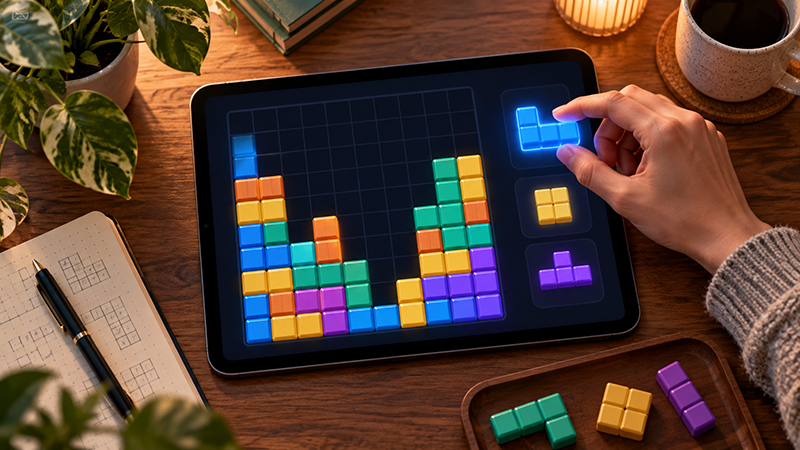
Combos reward consecutive or closely connected clears, depending on the game’s scoring behavior. They are valuable because they can increase the result of efficient play, but chasing them blindly often causes board damage.
A good combo setup usually has three features:
- An almost-complete line that can be finished with a safe placement.
- A second line that can be prepared without filling the board with temporary clutter.
- Enough open space to handle the next pieces if the ideal continuation does not appear.
The third feature is the one players forget. A combo is not a guarantee. The required piece may not appear, or another available block may become impossible to place. If preparing a combo requires filling multiple open areas with awkward fragments, the potential bonus may not justify the danger.
Think of combos as an opportunity, not an obligation. Take the chain when it develops naturally. If forcing it would create holes or a tall stack, choose the safer clear and protect the run.
Common Mistakes That End Good Runs
Playing too quickly
Fast placement is useful only when the position is obvious. Speed encourages players to focus on where a piece fits rather than whether it belongs there. A short pause before each placement is usually enough to notice a better order or a hidden hole.
Filling every available gap
Not every gap needs to be filled immediately. A gap may be valuable if it preserves a connected area or helps complete a line later. Treat empty space as a resource, not as unfinished work.
Saving one area for too long
The opposite mistake is refusing to use a safe region because it might be needed later. Space has value only when it helps you place pieces. If a section is broad and safe, use it while keeping another flexible area available.
Ignoring the worst-case piece
Players often plan around the piece they hope to receive. Stronger play considers the awkward piece that could arrive next. You do not need to predict the exact block, but you should avoid leaving a board that accepts only one narrow shape.
Creating isolated holes
Small enclosed holes are especially dangerous because many pieces cannot reach them. Before placing a block, check whether it will surround an empty cell on several sides. If it does, make sure that hole is part of a line you can realistically complete.
A Practical Decision Method for Difficult Turns
When the board becomes crowded, use a simple scoring system for each candidate placement. The exact numbers do not matter; the comparison does.
| Question | What a strong answer looks like |
|---|---|
| Does it clear something? | It completes one or more lines without damaging the board. |
| Does it preserve open space? | It leaves at least one broad, connected region. |
| Does it avoid holes? | It does not create isolated cells or unreachable pockets. |
| Does it support the other pieces? | It makes at least one remaining piece easier to place. |
| What happens if the next piece is awkward? | The board still has a safe fallback location. |
If one move clears a line but fails every other test, while another move clears nothing but preserves several options, the second move may be better. This method is especially useful when the board is crowded and emotional decisions become more likely.
How to Improve Consistently
Improvement comes faster when you analyze decisions rather than only celebrating scores. After a run ends, identify the first turn where the board became difficult. The final placement may have caused the loss, but the real mistake often happened several turns earlier when a useful region was blocked or a hole was created.
Ask yourself:
- Which placement reduced my options the most?
- Did I choose an immediate clear over a safer board?
- Did I fail to consider the other available pieces?
- Was I protecting a combo that was no longer realistic?
- Could I have kept a larger connected area open?
Practice one skill at a time. For several runs, focus only on avoiding isolated holes. Then focus on evaluating piece order. Later, practice setting up combos without sacrificing flexibility. A targeted approach makes progress easier to recognize than trying to improve every decision at once.
So, can you actually beat Block Blast? Yes, if “beating” means developing control over the board, extending your runs, and repeatedly exceeding your own previous results. The game may not offer a conventional final victory, but it does provide a clear test of planning under uncertainty. Place for the current turn, but judge every move by the options it leaves behind. That habit—not chasing every immediate clear—is what turns a lucky run into a repeatable strategy.


