The longest runs in Block Blast usually do not come from flashy placements. They come from players who keep the board usable. That is the real core of Block Blast space management: leaving yourself enough room for what comes next, not just forcing in the piece you have right now.
That is why some boards look calm even when the score is rising. The open spaces stay clean, awkward gaps are avoided, and each move protects the next few turns instead of only the current one. On Block Blast Online, that pattern is worth watching if you want steadier scores and fewer runs that fall apart after one bad shape.
Why space management matters more than single placements
Most players focus on finding somewhere for each block. That matters, but it is only the first layer. The harder part is choosing placements that keep the board flexible. A move can look efficient in the moment and still be a mistake if it creates pockets you cannot use later.
In Block Blast, space has value in three ways: it gives room for large pieces, room for awkward pieces, and room to recover after a poor draw. Lose one of those, and the board starts to close in fast. Strong players treat open space as a resource, not as leftover empty cells.
What good space actually looks like
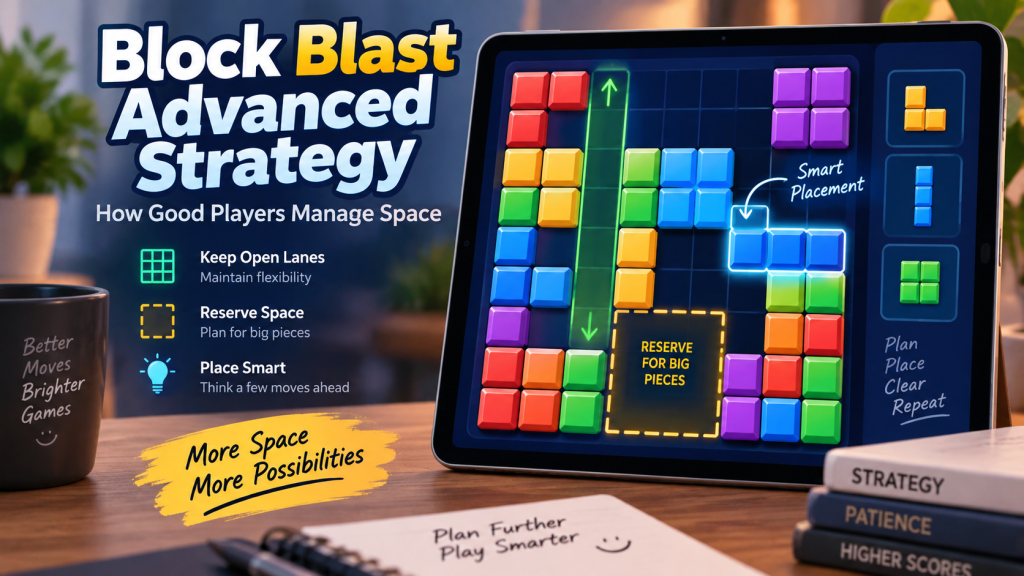
Good space is not just empty space. It is space that can still accept different shapes. Wide, clean areas are better than scattered holes. Straight edges are better than jagged edges. A board with one or two usable open zones is usually safer than a board with the same number of empty cells split across isolated gaps.
A simple test helps here: if a new piece could land in several places, the board is healthy. If it has only one possible home, pressure is already building.
How strong players handle the board differently
The biggest difference is that stronger players think in patterns, not single moves. They do not ask only, “Where does this piece fit?” They also ask, “What kind of board will this create?”
That changes how they place pieces. Instead of filling the first available notch, they often preserve larger open regions, keep rows and columns more even, and avoid cutting the board into disconnected zones. It is slower thinking, but it reduces forced moves later.
If you want a related breakdown on planning depth, the guide on how many moves ahead you should plan in Block Blast pairs well with this approach.
They protect the board’s shape, not just the score
Clearing lines feels productive, but a clear that opens a bad gap can be worse than no clear at all. Skilled players care more about the shape of the remaining board than about immediate cleanup. They prefer placements that preserve smooth edges and usable corners.
That matters even more once the board gets crowded. At that point, one awkward notch can trap a future long piece or force a corner placement that should have been avoided. A good run often survives because the player passed on a tempting but messy move earlier.
Where space usually disappears first
Space does not vanish evenly. It usually gets lost in a few predictable places. Once you know those pressure points, you can defend them earlier.
Corners turn into traps
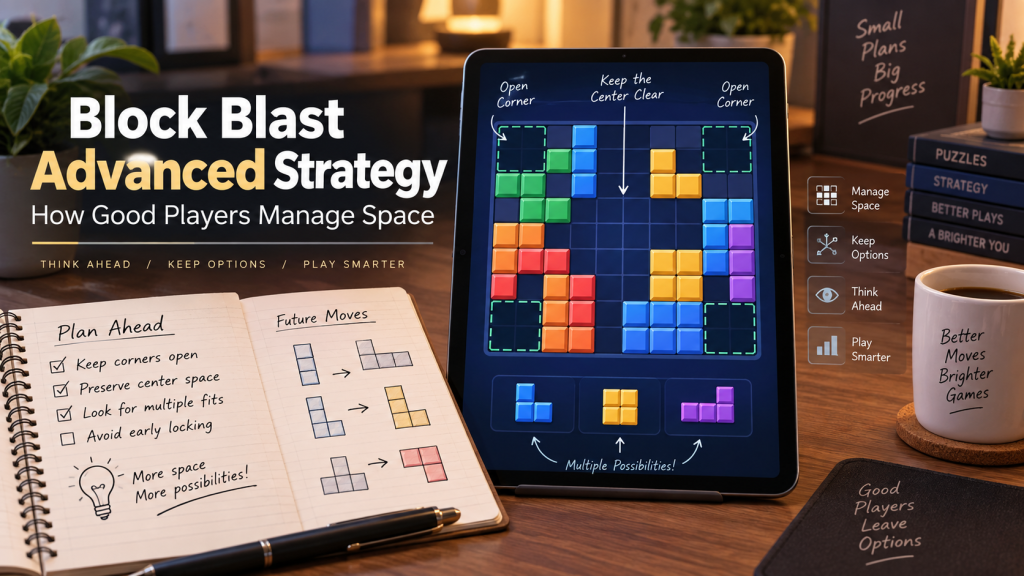
Corners are easy to ignore when the board is open. Later, they become some of the hardest spaces to use. A blocked corner can sit harmlessly for several turns and then become a real problem because the right piece never arrives. Good players are careful about packing corners too tightly unless the move clearly helps the overall shape.
Thin gaps become dead space
Single-cell or narrow gaps look harmless until a large piece arrives. Then they become dead space. If your board starts filling with these slices, you are no longer managing space—you are cleaning up after it.
A useful habit is to avoid creating gaps that only one very specific piece can use. The fewer special cases your board contains, the easier it is to keep playing.
One side of the board gets overloaded
Players often drift toward one corner or one edge because it feels tidy in the moment. The problem is that overloading one side makes the board lopsided. Once that side fills up, future placements become harder because the remaining open space is not shaped for the pieces you receive.
Keeping the board more balanced gives you more options. It also keeps the run from depending on one perfectly timed draw.
Placement habits that preserve space
Advanced strategy is not about memorizing a single best move. It is about building habits that keep your options open.
Prefer placements that keep large zones intact
When two moves both work, the better one is often the one that leaves a larger continuous area. A continuous zone can absorb several different shapes. Fragmented boards may look busy, but they are fragile.
If one placement fills a clean edge while another splits a large open area into two awkward pockets, the first is usually safer even if it looks less efficient at the moment.
Use edges to stabilize the center
Edges are useful because they are predictable. They can help you anchor pieces without breaking the center into too many pieces. A strong edge placement can buy time for the middle, which is where many boards become difficult.
This does not mean filling edges blindly. It means using them to support the board’s structure instead of treating them as dump zones for awkward pieces.
Do not rush to clear if the board is stable
New players often chase line clears too aggressively. Sometimes a clear is the right move, but not always. If your board is stable and open, a placement that preserves future flexibility can be better than one that forces an immediate clear with a poor follow-up shape.
Think of clears as a tool, not the goal. The goal is to keep the board playable for as long as possible.
When to save space and when to spend it
Space management is partly restraint and partly timing. You should not save space forever. Eventually, you have to use it. The trick is knowing when the board can afford to stay open and when you need to turn that space into progress.
Spending space makes sense when a placement prevents a dead corner, opens a clean lane for future large pieces, resets a crowded section before it becomes unusable, or fixes a board shape that is getting too narrow for the pieces you keep receiving.
Saving space is usually better when the board is already unstable, when a clear would split a healthy open area into smaller pockets, or when you still have enough room to wait for a better-fitting piece.
A simple rule works well: spend space when it improves the board’s shape, not just when it removes blocks.
Reading your pieces with more discipline
Good players do not look only at the current piece. They also scan the next two pieces mentally and ask what kind of space those shapes will need. That is why planning ahead matters so much in Block Blast. It is not about predicting the exact sequence; it is about avoiding placements that make common future shapes awkward.
Some pieces are forgiving. Others need width, straight edges, or a clean corner. If you know a piece type often causes trouble, do not spend your best open area on a move that leaves no room for it.
This is where the board and the pieces have to be read together. A placement that looks fine in isolation may be poor if it removes the only space that can handle a wider piece later.
Watch for the one perfect fit trap
A board that only accepts a future piece in one exact position is already risky. It means your margin for error is gone. Strong players avoid building boards that rely on one lucky fit because Block Blast rarely rewards that kind of dependence for long.
A practical way to think during each turn
If you want a simple mental routine, use this sequence before placing a block:
- Check whether the move creates a narrow gap or awkward corner.
- Look at the largest open area and ask whether it stays usable after the move.
- Compare the placement against the next likely shapes in your head.
- Choose the option that keeps the board most flexible, even if it is not the cleanest-looking move.
That routine is short enough to use in normal play, but it changes how you handle crowded boards. It shifts the focus from immediate fitting to board health.
Common space-management mistakes that end runs early
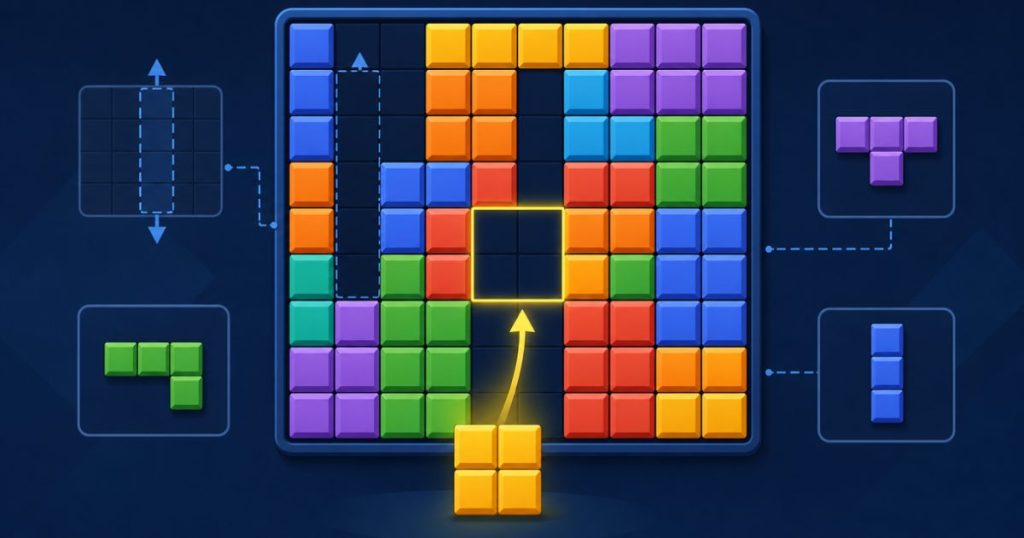
Some mistakes seem small because they do not end the run immediately. They just make the board less forgiving until the next awkward draw finishes it off.
- Filling the center too early: the middle of the board needs freedom longer than it first appears.
- Leaving tiny gaps: they look harmless, but they are often the first spaces to become unusable.
- Overcommitting to one side: this makes the board lopsided and harder to recover.
- Clearing for the sake of clearing: a line clear that harms the board shape can lower your long-term options.
- Ignoring the largest piece in hand: if you leave no room for it, you often force a bad move next.
If your scores keep falling short, it may be less about bad luck and more about these repeated habits. The related guide on why Block Blast scores stay low and which mistakes kill a run is useful for spotting patterns that quietly drain your progress.
What to do when the board starts to close in
Not every run gives you a clean, open board. Eventually, you will have to play from a cramped position. In those moments, space management becomes less about building the perfect board and more about surviving with the least damage.
The best response is usually to restore flexibility, not chase a dramatic clear. Sometimes that means placing a piece in a slightly awkward but stabilizing spot. Sometimes it means accepting a weaker move now so the next two turns remain possible. The goal is to reopen options, even if the board does not look pretty right away.
When the board is tight, overthinking can be as dangerous as rushing. Stick to the question that matters most: which move gives me the most usable space afterward?
What advanced players learn over time
After enough runs, most strong players stop seeing empty cells as blank space and start seeing them as future capacity. That shift changes everything. They become more patient with placements, more careful with corners, and less impressed by short-term line clears that ruin structure.
That is why Block Blast space management is worth practicing on its own, separate from raw scoring. A cleaner board makes better scores possible, but more importantly, it keeps you in control when the game stops being generous.
There is no single board pattern that guarantees a long run. Still, the same principle shows up again and again: preserve open shapes, avoid dead corners, and do not let the board fragment faster than you can recover it.
If you want more consistent runs, treat every placement as a decision about future space, not just present fit. The strongest Block Blast players are usually the ones who keep one or two usable regions alive for as long as possible, even when a tempting clear is available.
That habit is hard to fake once you start looking for it. A board that stays open longer gives you more ways to recover, more room for large pieces, and fewer turns where the game depends on luck alone.