In Block Blast, the best answer is usually not “as many moves as possible.” What matters more is knowing when to think 2–3 moves ahead and when to simplify your decision to save the board.
If you focus only on the block in front of you, it is easy to close off valuable space without realizing it. But trying to plan too far ahead can be just as harmful when the board is already crowded. You may spend too much time imagining a perfect sequence while missing the safest move available right now.
So, how many moves ahead in Block Blast should you think? There is no fixed number that works in every situation. A better approach is to use 2–3 moves as your default, then adjust depending on how much space is left, which block shapes are available, and how risky the current board has become.
That approach is much more useful in Block Blast Online than relying on reaction alone.
How Many Moves Ahead Should You Look in Block Blast?
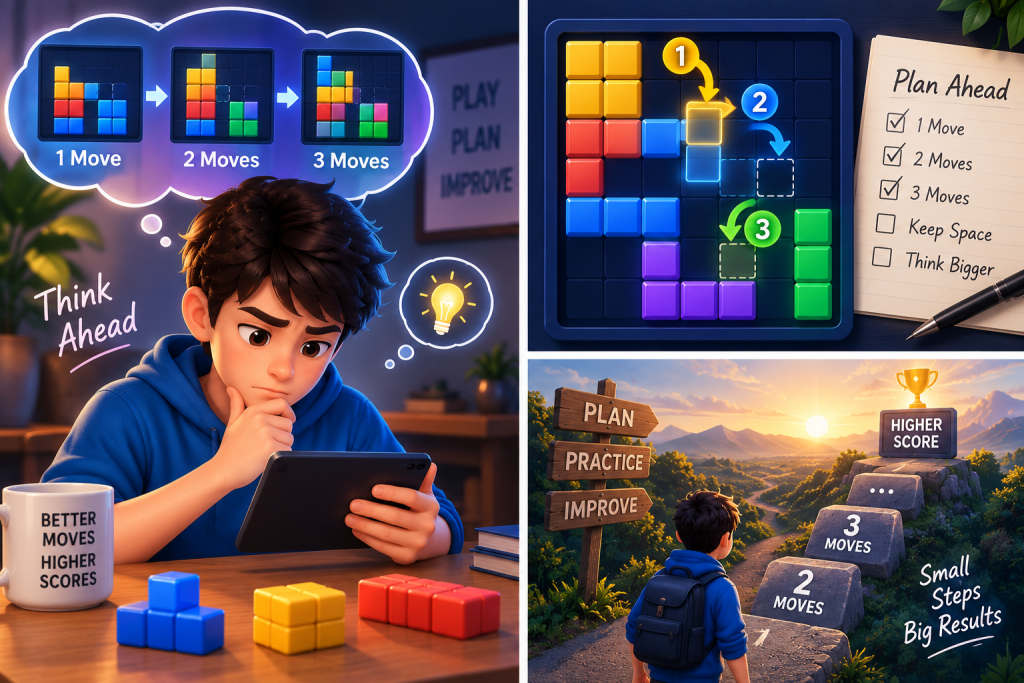
For most situations, thinking 2–3 moves ahead is the sweet spot.
It is far enough to stop you from making an obvious placement that ruins the next few turns, but not so far that you start planning around too many uncertain possibilities.
A practical way to think about it is:
- 1 move ahead: useful when the board is crowded and survival matters more than planning.
- 2 moves ahead: a good default for most turns.
- 3 moves ahead: useful when several placements are possible and you need to compare which one preserves more space.
- 4 or more moves ahead: worth considering only when the board is open and you are comfortable reading future placements quickly.
If you are still developing your board-reading skills, start with 2–3 moves.
That is usually enough to avoid major mistakes without making every turn feel complicated.
When Should You Think Only One Move Ahead?
More planning is not always better.
There are situations where the best decision is simply to find the safest placement available and make it.
When the Board Is Already Crowded
Once the board has broken into small pockets, long-term planning becomes less useful.
At that point, survival is the priority. A simple move that keeps one important area open may be worth far more than a clever three-move sequence that depends on everything going perfectly.
When the board is tight, focus on avoiding immediate damage.
When a Block Perfectly Fits a Dangerous Gap
Sometimes one of your available pieces fits an awkward space almost perfectly.
If that space is difficult to use with other shapes, it often makes sense to deal with it immediately rather than saving the block for a larger plan.
Passing up a rare clean fit can create problems later.
When You Need to Protect Space for a Difficult Shape
Certain blocks become almost impossible to place once a specific row, column, or open area disappears.
If you can see that one piece depends on a particular space, protecting that space may matter more than building a complicated sequence.
In those situations, short-term board survival comes first.
When Should You Think 3–4 Moves Ahead?
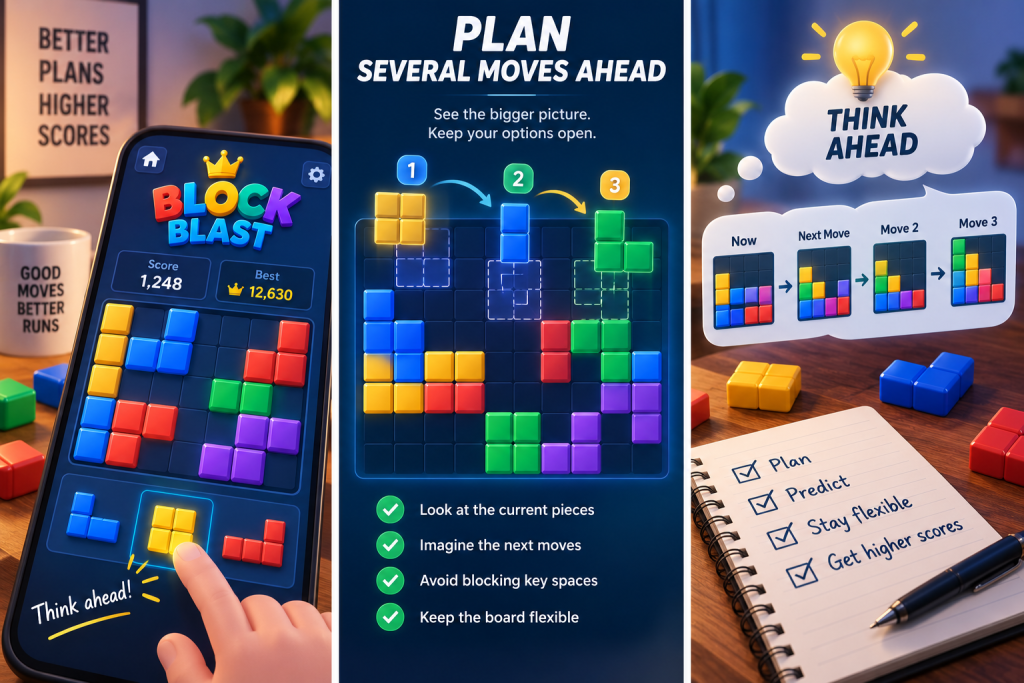
Thinking further ahead becomes much more valuable when the board gives you options.
This is where better players often separate themselves from purely reactive play.
When the Board Is Still Open
An open board gives you flexibility.
Because several placements may work, you can afford to think beyond the immediate move and ask which option leaves the healthiest structure afterward.
This is a good time to protect large open areas and avoid creating unnecessary gaps.
When Several Placements Look Equally Good
If two or three moves all appear safe, do not automatically choose the one that clears something immediately.
Instead, compare what the board will look like afterward.
Ask:
- Which placement keeps more usable space?
- Which one leaves room for larger pieces?
- Which one creates fewer awkward gaps?
- Which one gives the remaining blocks more options?
This kind of comparison is often more valuable than chasing an immediate clear.
When You Need to Prepare for a Large or Awkward Piece
Large squares, long bars, and awkward shapes need more deliberate planning.
If one of those pieces is difficult to place, thinking 3–4 moves ahead can help you avoid using up the only space that fits it.
A useful rule is simple:
If the current turn is not urgent, spend a little more time thinking about how your move affects the next 2–3 placements.
You do not need to calculate the entire run.
A Practical Checklist Before Every Move
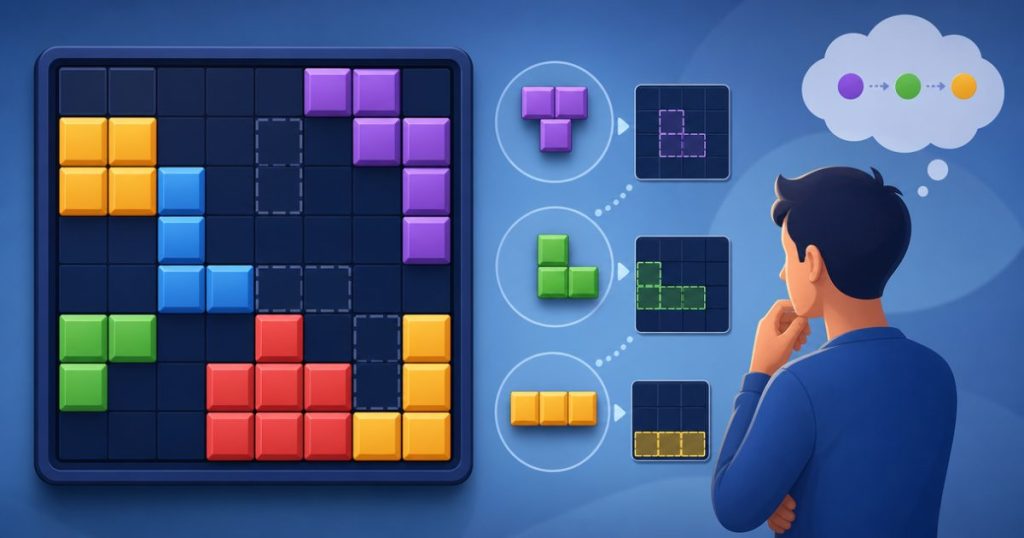
Instead of trying to count exactly how many moves ahead you are thinking, use a short decision filter.
Before placing a block, ask:
- Will this move destroy an important open area?
- Will I still have at least one flexible region after placing it?
- Can the other available blocks still be placed safely?
- Am I giving up a better opportunity by using this space now?
These questions take only a few seconds, but they can prevent many rushed mistakes.
That makes them well suited to Block Blast, where every placement immediately changes the value of the remaining space.
The Problem With Thinking Too Far Ahead
Some players assume that better strategy means planning as many moves ahead as possible.
That is not necessarily true.
Planning too far can create new mistakes of its own.
You Start Depending on an Imaginary Sequence
You may picture a perfect three- or four-move setup, but the first placement could already weaken the board.
If the plan depends on too many things going right, it may not be worth following.
You Ignore the Current Board Structure
Future planning is only useful if the board remains flexible.
A move that seems good several steps later can still be bad if it creates narrow gaps, isolates empty cells, or removes the only large open region.
Always evaluate the immediate board first.
You Focus Too Much on the Current Pieces
It is easy to build a plan around the pieces you have while forgetting that future blocks may require very different shapes of space.
Good Block Blast strategy is less about creating a perfect pattern and more about keeping multiple possibilities alive.
You Use the Same Planning Depth in Every Situation
This is one of the biggest mistakes.
When the board is open, looking three moves ahead makes sense.
When the board is nearly full, that same approach may be unnecessary. You may need to focus almost entirely on finding one move that keeps the run alive.
Your planning depth should change with the board.
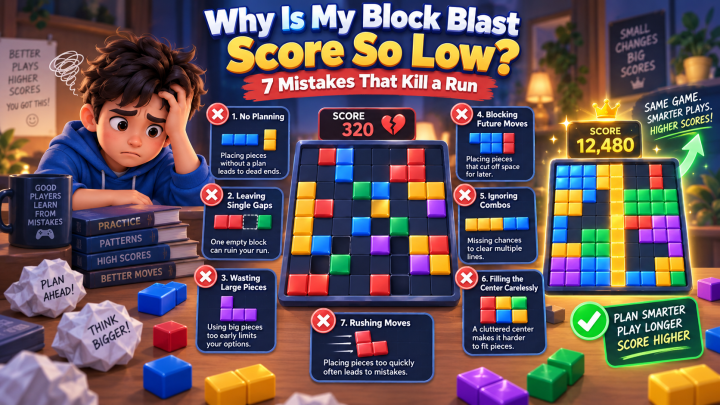
If your runs often end because of these kinds of decisions, the guide on 7 mistakes that keep your Block Blast score low covers several common placement habits that shorten runs.
How to Practice Thinking Ahead Without Overcomplicating the Game
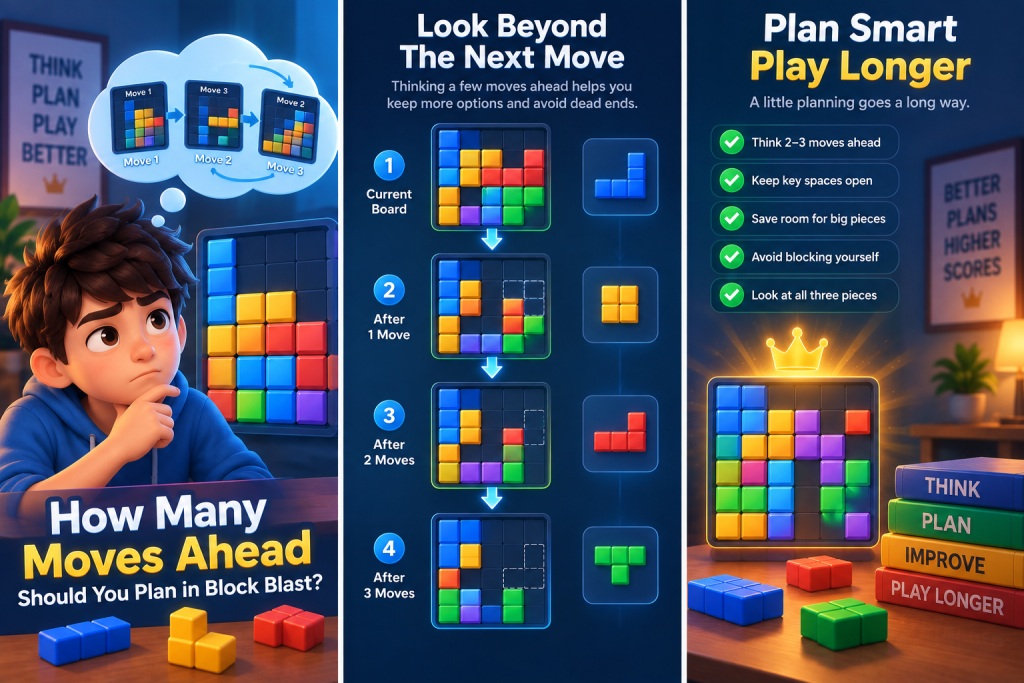
New players often make the mistake of trying to visualize too much at once.
A simpler approach is to divide your thinking into two layers.
Step 1: Evaluate the Current Placement
First, identify:
- the safest area,
- the most valuable open space,
- the most dangerous gap,
- and the block that is hardest to place.
Do not worry about a long sequence yet.
Just understand what the current board needs.
Step 2: Check What Happens Afterward
Before committing to the move, ask one more question:
If I place this block here, will the next difficult piece still have somewhere to go?
That one extra check already puts you ahead of purely reactive play.
Over time, this becomes automatic. You will start recognizing when a position deserves a deeper 3–4 move calculation and when the safest one-move solution is enough.
That adaptability is much more useful than forcing yourself to think the same number of moves ahead on every turn.
Should You Prioritize the Next Move or Future Space?
When the two conflict, future flexibility usually matters more—unless the board is already in immediate danger.
For example, an instant line clear may look attractive, but if it destroys the only large empty area on the board, it could make the following pieces much harder to place.
On the other hand, if the board is almost full, refusing a safe clear because you are saving space for a theoretical future setup can also be a mistake.
A better priority order is:
- Avoid an immediate loss.
- Protect difficult-to-replace open space.
- Keep options available for the remaining blocks.
- Chase points and line clears when they also improve the board.
This keeps your strategy focused on survival first and scoring second.
So, What Is the Best Number of Moves to Think Ahead?
If you want one simple answer, start with 2–3 moves ahead.
That gives you a good balance between speed and control.
When the board is open, you can sometimes extend your planning to 3–4 moves. When the board becomes crowded, reduce the complexity and focus on the safest placement in front of you.
The most important skill is not calculating farther than everyone else.
It is knowing how far ahead the current board actually requires you to think.
Frequently Asked Questions
Is thinking 2 moves ahead enough in Block Blast?
For many situations, yes. Thinking two moves ahead is already enough to prevent a lot of bad placements because it forces you to consider what your current move leaves behind.
Should advanced players think 4 or 5 moves ahead?
Sometimes, but not on every turn. Thinking that far ahead is most useful when the board is open and several placement sequences are possible. On a crowded board, shorter and safer calculations are usually more practical.
Is it bad to only think about the current move?
It becomes risky if you do it constantly. A placement can look harmless now but remove the only useful space for another piece. Even one extra step of planning can help prevent this.
What should I look at when planning future moves?
Focus on open space, difficult block shapes, narrow gaps, and whether the remaining pieces still have safe placements after your move.
Does thinking farther ahead always improve your score?
No. Better planning helps, but overthinking can also lead to poor decisions. The goal is to think far enough to preserve flexibility, not to predict every future move.
Final Thoughts
For most players, 2–3 moves ahead is the most practical way to think in Block Blast.
Looking only at the current placement can make you close important spaces too early, while trying to calculate too many moves can make simple decisions unnecessarily difficult.
The stronger approach is flexible: think further ahead when the board is open, shorten your planning when the board becomes crowded, and always protect the space that gives you the most future options.
Once this becomes a habit, your moves start to feel more intentional. You do not need to predict the entire game—you only need to keep enough good options available for the next few turns.