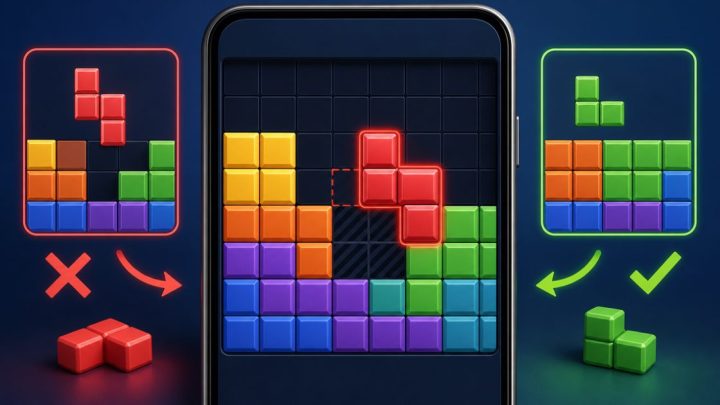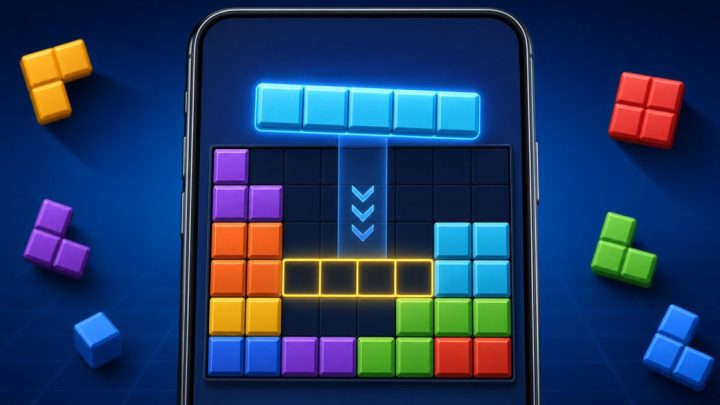
Yes, the first move in Game Block Blast Online matters. Not because there is one perfect opening that works every time, but because your first placement shapes the board you’ll be playing on for the next several turns. A good opening keeps your options open. A bad one can create awkward gaps, split the board into smaller sections, or make an ordinary piece harder to place later.
The safest first move is usually the one that preserves the largest connected open area and avoids unnecessary holes. That often means an edge or corner placement, but not always. The real goal is flexibility: keep the board easy to read, easy to fill, and easy to recover when the game gives you an awkward piece.
What makes a first move safe in Block Blast
A safe first move is one that prevents future problems instead of just placing the piece quickly. In Block Blast, that means your opening should leave you with simple, connected space rather than a board broken into narrow lanes and isolated pockets.
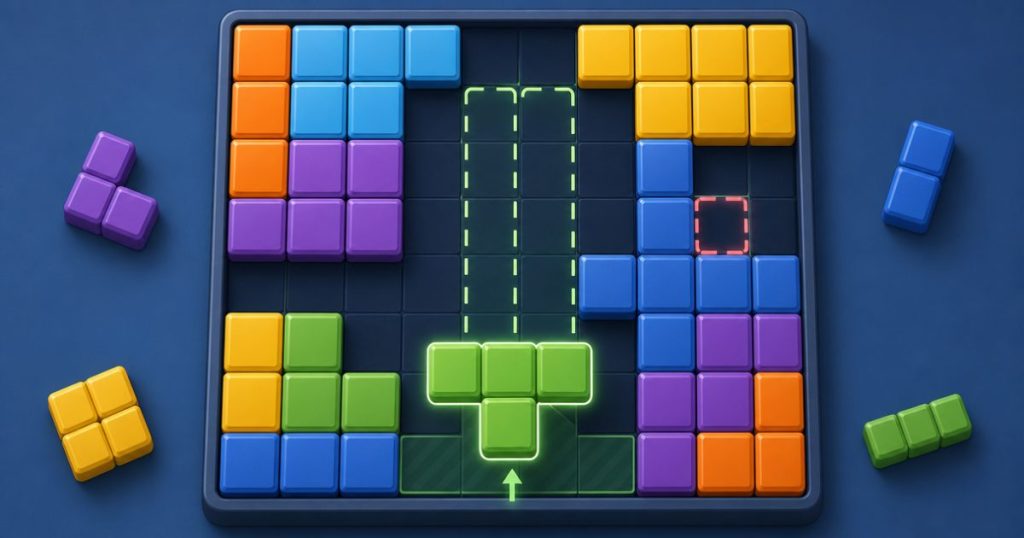
Think of the board as a storage area. A safe opening keeps that space roomy and organized. It doesn’t leave a single square trapped behind a shape you can’t easily fill. It doesn’t split the board into two separate zones too early. And it doesn’t use up the most flexible space just because the placement looks neat right away.
In practice, a safe move usually does three things:
- Leaves a large open region available for later pieces.
- Avoids creating tiny holes that are hard to fill with common shapes.
- Keeps more than one part of the board usable, so you don’t get locked into one narrow lane.
That’s why the safest move is often not the placement that scores the most immediate points. Early in a run, board shape matters more than points. If you protect the shape, the score usually follows.
Why the opening move changes the rest of the run
Block Blast is less about the value of one placement and more about the shape that placement leaves behind. One move can make the next three moves easy or awkward. It can also decide whether you survive long enough to use a strong piece later.
The opening matters most because the board still has the most freedom at the start. A smart move uses that freedom to keep the board simple. A careless move spends it too early and creates problems before you’ve had a chance to build a stable pattern.
This is also why the first move matters more on a tight board than on a board with plenty of room. If the board is already crowded, even a small mistake can create a trap. If the board is open, you can sometimes recover from a mediocre opening. But even then, a cleaner first move usually makes the rest of the run easier.
For a closer look at the kind of board shape that often ends runs, see The Block Blast 3×3 Problem. It explains why small gaps become such a big issue later.
The default opening rule: protect open space and avoid fragmentation
If you want one simple rule for the first turn, use this: choose the placement that keeps the board most connected. In plain terms, pick the move that preserves one large, easy-to-use open area instead of several smaller areas separated by awkward gaps.
That usually means avoiding placements that cut the board apart too early. A shape dropped in the wrong spot can divide your open space into two regions that both look usable but neither is quite large enough for future pieces. Once that happens, you may have room on paper but not the right room for the next shape.
Edge and corner placements often help because they tend to keep the middle open. The center is where fragmentation usually hurts most. A central placement can create islands of space on both sides, and those islands may be too small for larger pieces later. An edge placement is not automatically safe, but it often preserves a cleaner board shape.
A good opening also avoids creating single-square holes or narrow notches unless the piece naturally fits there cleanly. If a move leaves behind a shape you already know will be hard to complete, it is usually not the safest choice, even if it looks tidy for the moment.
How to choose between two legal opening moves
When you have more than one place to put the opening piece, don’t ask which move looks neatest. Ask which move leaves the board easiest to work with. That usually comes down to a quick check of future fit options.
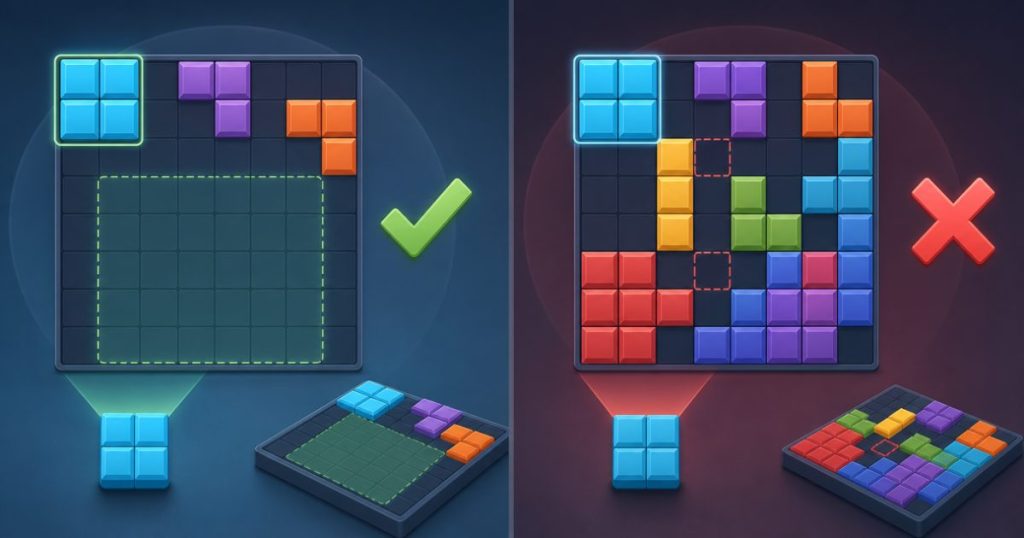
- Look for the largest open area after the move. Bigger connected space is usually better than smaller broken space.
- Check whether the move creates a hole or notch. If it does, think about whether common future pieces could actually fill it.
- Prefer placements that keep multiple lines usable. A move that leaves both a long row and a broad open area is often safer than one that only looks clean.
- Avoid making the board depend on one exact shape. If only a very specific piece can save the position, the opening was probably too narrow.
A simple example helps. Suppose you can place a piece either along the top edge or near the center. The edge placement may seem less efficient because it doesn’t use the middle space immediately. But if the center placement breaks the board into two awkward regions, the edge move is safer because it preserves flexibility. The best opening is often the one that looks less dramatic but keeps the board more playable.
There is one important exception: if an edge placement creates a long thin lane that will be hard to use later, that move may be worse than a carefully chosen central placement. That’s why “always play the corner” is too simple. The shape of the piece matters just as much as the part of the board you place it on.
When the center is actually the better opening
Sometimes the center is the right answer, especially when the piece itself is awkward and fits more naturally in the middle. A central placement can be better if it preserves a large, clean open area around it and doesn’t leave isolated corners behind. The key is not location alone. It’s whether the move keeps future options broad.
For example, a piece with an odd shape may fit the center in a way that leaves the outer board intact and easy to use. In that case, forcing the move into a corner might create a worse board shape. The safest move is the one that protects future placement choices, even if that means putting the first piece somewhere less obvious.
Common early mistakes that look harmless
Some of the worst opening mistakes are subtle because they don’t feel risky at the time. The board still looks open, and the piece still fits. The problem shows up later, when you realize the opening has quietly made the board harder to use.
One common mistake is placing the first piece in the center just because the space is there. That can divide the board too early and make later placements awkward. Another mistake is creating a tiny pocket next to the first piece that no common shape can cleanly fill. A third is using the only broad open region on a move that could have gone somewhere safer.
A move can also be risky if it looks neat but forces the board into a long, narrow pattern. Narrow space is dangerous in Block Blast because many pieces need width or height to fit comfortably. If your opening creates a lane that only one shape can use, you may have trapped yourself before the run really starts.
When the first piece is a long bar, planning gets even more important. If that’s the piece you’re dealing with, it helps to think ahead about where long pieces usually survive best. Our Block Blast long bar strategy guide covers lane-building habits and common mistakes with that shape.
Safe first move versus high-score first move

A safe first move and a high-score first move are not always the same thing. A safe move is about survival and flexibility. A high-score move is about setting up future clears, combos, and efficient board use. Most of the time, those goals overlap. When they don’t, survival should usually come first.
Early in the run, a high-score move that damages the board can be a bad trade. You may gain a small immediate advantage but lose the structure you need to keep scoring later. On the other hand, a slightly conservative opening that preserves space can help you survive longer and create better scoring chances later.
This is why board management matters more than any single placement. The first move is not a test of perfect optimization. It’s a setup decision. If you keep the board flexible, you give yourself more chances to build chains, clear space efficiently, and avoid the dead board that ends a run early.
If the board is already getting crowded, a recovery mindset becomes more important than perfect opening theory. That’s where a simple reset-style approach helps. This article on how to recover when the board gets too full is useful when a run starts slipping away.
A practical rule for move one
If you want a fast decision rule, use this:
- Choose the placement that leaves the largest connected open space.
- Avoid creating holes, notches, or split regions unless the move clearly helps future pieces.
- Prefer edges or corners when they preserve flexibility, but don’t force them if they make the board worse.
- If two moves look similar, take the one that keeps more future shapes playable.
That rule is simple enough to use in real time, but it also reflects how Block Blast actually punishes mistakes. The game rewards space management, not just clean-looking placements. A safe first move is one that helps you survive the next piece, the next three pieces, and the awkward piece after that.
If you hesitate, ask one question: which move makes the board easier to read one turn later? That answer is usually the safer opening.
A quick example of a good first-move habit
Imagine you receive a piece that can fit in two places. One placement fills a corner and leaves a broad open middle. The other sits near the center and leaves two smaller sections around it. The corner move is usually safer because it keeps the board simple and connected.
Now imagine a piece that fits awkwardly in the corner and leaves a single thin gap behind it. In that case, the center placement may be better if it preserves one large area instead of making the board messy. The goal is not to favor one part of the board no matter what. It is to keep future options alive.
Frequently Asked Questions
Does the first move in Block Blast really matter?
Yes. It matters as a setup decision because the opening placement affects how open, connected, and flexible the board stays for later moves.
Is the safest first move always in a corner?
No. Corners and edges are often safer, but only if they preserve open space and don’t create awkward gaps or narrow lanes.
Should I ever open in the center?
Yes, if the piece fits more cleanly there and the move keeps the board connected. A center placement is fine when it doesn’t fragment the board.
What’s the easiest rule to follow on move one?
Choose the placement that leaves the largest connected open area and avoids creating holes that future pieces can’t easily fill.
The safest first move in Block Blast is usually the one that preserves the most usable space, not the one that looks tidiest or scores the most immediately. If the board stays open, connected, and free of awkward little gaps, you give yourself a much better chance of surviving the next few turns.
When in doubt, favor flexibility over greed. Pick the move that keeps the board easiest to work with, especially when you’re choosing between an edge placement and a center placement. That one habit will help more than chasing a single “best” opening ever could.